Summary: Fixed-order tensor currents give a common geometric contact with band-independent coherent elastic vertices, a depth-dependent source count and reciprocal spatial dynamics, while the simplex mass term and master-field realization remain inputs.
Separate the mass count from the current being compared
A mass band can contain many coefficients while an interaction reads a fixed number of spatial tensor indices. That distinction gives a concrete inverse construction with different masses and a common coherent elastic vertex. Its initial coupling source has a count fixed by physical depth, even when the mass-band count changes greatly.
The construction below specifies the simplex mass operator. It does not derive that operator from the original master action. What is derived is the complete response of a common interaction added to it: both source variations, the canonical vertex, its geometric zeros, its full coherent Hessian and its effect on spatial fields. There is one interaction coefficient within a physical sector, rather than one coefficient per pair.
The components of and its tensor powers are coefficient data over an actual physical point. They add no physical spatial dimensions. The directions of remain ordinary macroscopic spatial directions.
For this inverse action, the retained grades are independent, canonically normalized components of one effective field. Their interpretation as a reduction of is an assumption. In particular, they are not silently identified with constrained derivatives of one smaller spinor. Only spatial sectors are nested; individual particles are not nested objects.
A trace-preserving geometric current
For a fixed integer , split off tensor indices using the isometry
In normalized occupation states, with and , its nonzero coefficient is
Here . The multinomial Vandermonde identity gives . The two tensor factors in (2) are groups of field indices, not constituent particles.
Let retain all its ordinary spatial spinor components. Contract the spectator indices in using the scalar spinor bilinear :
The current is Hermitian. It need not be positive for a general Dirac field; none of the full variation below replaces it by a positive density. At a coherent field , with ,
Thus the same geometric pattern has the same retained current at different . This follows from a trace-preserving contraction; no division by the particle mass has been made.
The dual operator for a Hermitian current on is
It is unital, , and . With the declared canonical kinetic metric, (6) is the normalized two-matter-leg vertex for this current. The general normalization rule still applies if a different master reduction supplies a nontrivial metric.
For , is the average of acting on each of the indices. A geometric rotation generator instead sums those actions. The averaged intensity current is therefore not automatically a Noether charge or the electric current.
The diagonal coherent vertex is independent of , but a transition between different rays retains the spectators:
Equal elastic vertices do not imply equal transition form factors, polarizabilities or response times.
The minimal adjacent-current contact
For a finite set of grades with , set
Consider the real potential density
At one physical depth, has units of energy and has units of energy times spatial volume when the canonical norm is dimensionless. Comparing absolute coefficients at different depths additionally requires the physical normal integrals and their kinetic normalization. A dimensionless fibre comparison does not supply those factors.
There is a limited minimality argument for (8). Restrict the ansatz to the three isotropic contractions , and . For two coherent patterns their common quartic cross term is a polynomial , where . Preserving an isolated coherent mass at every amplitude requires its value at to vanish. Requiring the complete interaction to vanish for orthogonal coherent patterns requires . The smallest nonzero polynomial satisfying both conditions is proportional to , which gives (8).
This is uniqueness within that specified contraction ansatz. Physical rotation covariance alone permits additional tensor and spinor invariants. Neither the ansatz nor the mass polynomial in (8) has been obtained from the original master interaction.
With the full self-adjoint spatial Dirac operator , use the canonical action
Varying every current in (8) gives
No target current is frozen. Each partner's source is the derivative of the same real potential, so its full real Hessian is reciprocal. All complex spinor components and relative phases remain in (4) and (10). The action is invariant under an independent phase of every retained grade and conserves each grade's canonical norm. It therefore has no vertex converting one mass grade into another. Such conversion processes would require additional terms from the common master reduction.
The action is a smooth local polynomial on the independent carrier, including scalar-null fields and the vacuum. It preserves the principal Dirac symbol. The usual local difference-energy estimate consequently gives finite propagation for smooth solutions on their interval of existence. It does not prove global nonlinear existence or a complete spacetime-covariant embedding of the proposed mode bundle.
Exact masses and the complete coherent response
For an isolated coherent field, both terms in the square brackets of (10) act as on its occupied vector. The entire interaction source vanishes. Its mass remains , including its complementary equations.
That geometry has unknown physical radius and volume; its mathematically compact topology is not a compactification of extra dimensions. For the holomorphic section described there, take
The full connection gives and . Therefore
Several grades with the same local ray also have zero complete interaction source, even when their densities differ. Equation (12) then holds for that joint configuration. At common , the unchanged degrees give . This preserves the input simplex relationship; it is not a new derivation of the observed lepton masses or of the selected canonical norm.
The response must include the current variation. At a coherent field in the frame , let project onto transverse occupation and define
with an unavailable binomial set to zero. For , the complete interaction Hessian has the spin block
The interaction block is zero. The formula is polynomial in ; it does not divide by .
To derive (14), split a degree- transverse occupation using (3). Its probability of leaving all retained indices in is . Its off-diagonal contraction with the coherent vector is nonzero only when all transverse indices are retained; that coefficient is . These two terms give the ordinary derivative. A conjugate term would need opposite transverse occupations; only the radial term can contribute, and the two adjacent currents cancel it. This proves (14) for the entire spinor multiplet.
For a positive-chirality occupied spin line, the interaction coefficient vanishes, as required for a moving coherent ray. At it is . The other spinor polarizations are retained in (14), rather than inferred from that one coefficient.
Every block is Hermitian. On the exact spatial field (11), the rotating linearization is the actual spatial Dirac operator plus a smooth bounded Hermitian endomorphism. It is self-adjoint and conserves the complete positive perturbation norm. This is full spatial linear stability, not nonlinear orbital stability, confinement or a physical identification of the independent carrier. No unproved global ordering of the two current purities is needed for that conclusion.
The pair vertex and its Hockey-Stick source count
Take two independent coherent grades with scalar intensities and mode rays . Equations (5) and (8) give exactly
There is no factor , , or in this elastic current vertex. Its geometric factor also has the projector identity
Aligned and orthogonal projectors commute. In both cases the complete cross-source vanishes, not only its expectation value. For positive coherent mixtures the interaction can likewise be written as a weighted sum of these squared commutators. A general field need not have such a positive coherent-mixture representation, so that observation is not a global positivity proof for arbitrary Dirac fields.
For the full initial source, set , with and . After factoring out , the coefficients in the first grade are
The reciprocal source exchanges the two fields. In particular, the term drives a genuine deformation outside the coherent-ray tangent space. At , the first-order ray motion vanishes while this deformation remains nonzero.
Allowing every partner orientation spans the complete degree- transverse spaces through . Their ranks are . Thus the initial source count is the Hockey-Stick identity
At depths these counts are . They are source-channel counts for the specified current, not counts of observed gauge vertices. In contrast to , they do not grow when the occupied mass band changes at fixed depth. Later evolution can populate higher occupations through repeated action of the full equation; (18) does not justify truncating the evolving field to these initial terms.
Canonical shape response still knows . The coherent-ray kinetic metric is times its projective metric. For an aligned pair, a canonically normalized tangent direction has the interaction block
It has one common-rotation zero mode and one frequency . Equation (19) is why a common elastic vertex should not be reported as equality of all dynamical susceptibilities.
Interference within one grade
Two contributions to the same field grade are not orthogonal carrier blocks. Write , , and . Retaining the off-diagonal contractions gives
For , this is (15) times when . The explicit form (20) also covers zero scalar products without division.
To verify it, the cross term in is plus its adjoint. Squaring the two complete currents cancels the terms linear in this cross term and leaves (20).
The initial potential is independent of a relative phase assigned to one contribution. Their combined canonical norm includes interference, and the general field equation still retains complex phase. A two-mode description must include its Gram matrix before treating the amplitudes as canonical independent coordinates. Equation (20) is not a derivation of particle statistics or an antiparticle mechanism.
Reciprocal deformation
The complete coefficient dynamics can be tested without a two-ray restriction. A positive-spin preparation on two geometric directions stays in because its full conserved rotation moment has support there. All and complex coefficients evolve. This is an invariant-subspace argument for this preparation, rather than a declaration that the physical sector has only two dimensions.
With , , unit norms and , an initial ray overlap gives first-index compatibility from to approximately , and second-index compatibility from to approximately , over the tested interval of 150 time units. Starting at gives the corresponding ranges to and to . Both patterns deform.
For these coherent initial preparations, conservation of gives the exact balance
The inequality uses positivity in this coefficient preparation. It is relative to the initial coherent state and does not imply monotonic alignment for arbitrary fields. Reversed complex preparations give the reversed motion. General spatial Dirac currents need not be positive, and their actual transport must be retained.
An actual spatial Dirac encounter
Equation (10) also permits a direct spatial control, with both fields evolving. Use a flat six-dimensional spatial patch and let one ordinary coordinate vary, keeping translation invariance in the other five. These are cylindrical pulse controls with norms per unit transverse volume, not localized six-dimensional bound particles.
The calculation retains all eight spinor components and all complex coefficients in the invariant two-direction preparation. The rest masses are prescribed as and , with , unit norms, Gaussian widths , initial centers , and central momenta . Both spinors have complex polarization. The two coherent mode rays initially obey . The central-momentum spin preparation is an initial Dirac pulse; it is not a solved bound state or an exact positive-energy spectral packet.
Through time , the full equations give
Both spatial patterns deform. Their density-weighted two-index mode purities change from one to approximately and . Here purity uses the positive spin contraction, rather than the signed scalar current: if is that contraction and , the reported quantity is .
Exact Fourier Dirac steps alternate with the local nonlinear update. In a spatial interval of length , a -point grid with time step gives energy drift below , norm drift below and total momentum drift below . Doubling the time step changes the final individual momenta by less than and the complete complex fields by less than in canonical norm. The comparison uses the same phases and masses, without fitting either endpoint.
An independent -point grid at the same time step changes the two complete endpoint fields by less than in . The largest boundary-region density across the three controls is below . These comparisons resolve the reported transfer and deformation against the tested numerical discretizations.
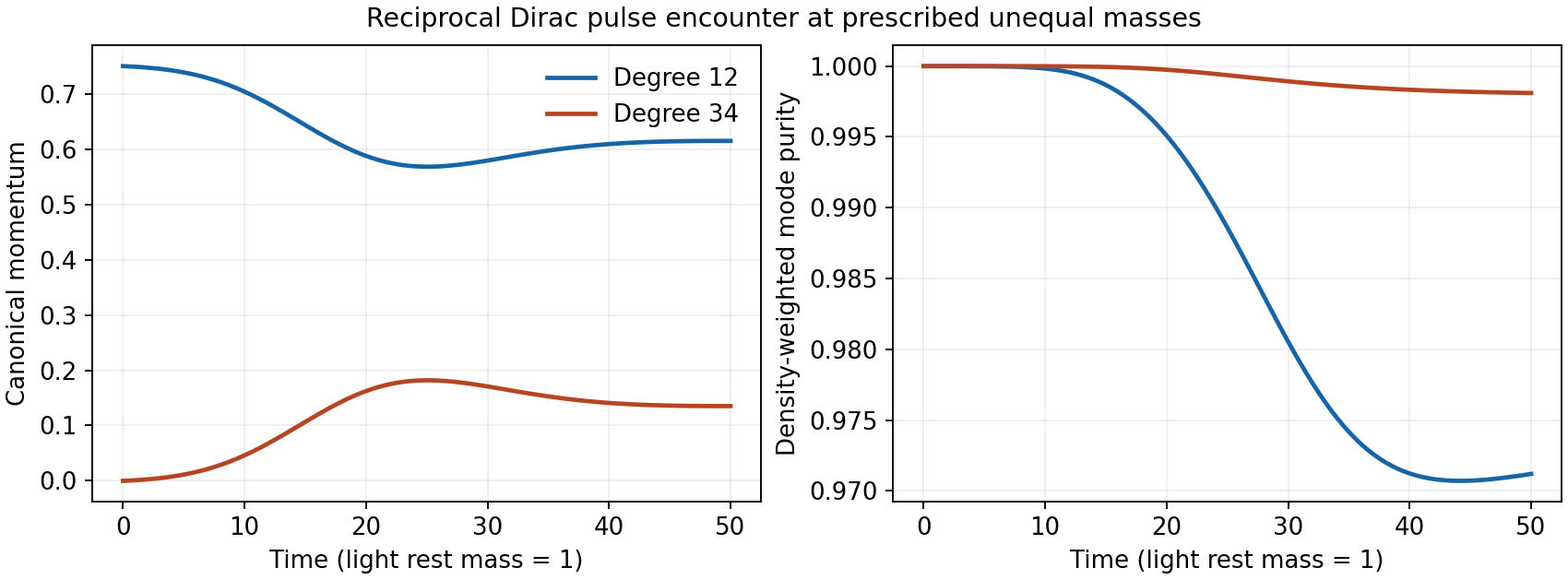
The spatial verification record retains the complete field comparisons and hashes of the source and raw states. The figure uses the finer time step and spatial grid.
The residual interaction energy is about at the endpoint. This is a resolved finite-time encounter, not an asymptotic scattering amplitude or a measured interaction rate. It demonstrates reciprocal momentum and shape response under the proposed action; it does not identify these pulses with the physical electron and muon.
Physical depth, orientation and the neutrino test
The current maps compare actual tensor directions in nested tangent spaces. They must transform together with both fields and the physical inclusion. For example, a coherent higher ray has zero restricted -index current when it is orthogonal to the entire specified lower space. This is a geometric condition on the occupied pattern, not a depth-specific coefficient.
Physical rotation averages are different from averages over all complex mode rays. For real unit vectors in ordinary spatial directions,
Complex polarization retains more information. For , define and for two complex unit directions. The complete physical rotation average is
To derive (23), decompose each symmetric square into its trace and traceless symmetric tensor. Their squared norms are and . The traceless representation has dimension ; averaging over physical rotations pairs equal irreducible components and removes unequal ones. Both polarization invariants remain. At , the two oriented helicities must be treated separately; replacing them by this single traceless representation would lose their distinction.
These formulas do not make a generic five-dimensional pattern unusually weak. The real-polarization value is at depth five and at depth six. The assigned neutrino degrees have the same coherent vertex formula as the charged-lepton degrees; no small neutrino coefficient has appeared.
Moreover, a pattern invisible to one fixed photon plane can be visible to another allowed orientation. If all planes in the shared three-space are admissible, a coherent vector invisible to every one must lie normal to that entire space. This same simple restricted current would then also be invisible to a probe confined to those three directions. The calculation therefore has not derived zero ordinary electric charge together with the observed nonzero weak response. The neutrino channel requirement still needs the selected physical state and the actual electromagnetic and weak current maps.
Equations (22) and (23) are dimensionless geometric comparisons. They are not interaction rates or a substitute for physical spatial normalization.
Canonical spatial overlap still matters
The local identity (15) does not remove the physical envelopes from an integrated particle vertex. This can be tested on the exact fields (11), without assuming a constant spatial density for the massive state.
Keep and compare the two holomorphic patterns and . The angle changes their complex tangent polarization relative to the slack component; it is not a global phase of the entire field. Both have the same . Their pointwise overlap is
With , the dimensionless spatial pair coefficient is exactly
The physical initial interaction energy for independent grades is . This is an initial matrix element between exact isolated fields, not a solved interacting stationary pair. The exact factorial expression for and independent positive spatial cubature give the following values.
| Degrees | ||
|---|---|---|
The diagonal entries are bilinear current reference values. Two fields in one grade also have the interference and canonical Gram terms in (20); those diagonal references must not be called complete same-grade particle interactions. The off-diagonal entry needs no such identification.
A complementary comparison holds the probe's physical density constant at , with the same normalized local ray for both massive branches. The probe can be an admissible initial field in one common retained grade; no stationary particle has been selected for it. Its dimensionless occupied vertex is
At , and : the same probe gives very similar response despite the prescribed mass ratio . At , the values are and . Near a geometric zero, differences in the occupied spatial profiles matter greatly.
Thus this action demonstrates a possible grouping of elastic responses, but not equality for every polarization or resolved encounter. The calculations use one physical volume, one coupling coefficient and the same normalization law. No mass division or separate fitted coefficient produces the comparison. Deriving the actual particle profiles and their observed current remains essential.
A constraint on deriving this contact from the master quartic
The interaction in (8) cannot be obtained by a bare complex-linear projection of a positive sum of squared Hermitian scalar currents onto the full independent carrier. This restriction can be proved using only positive-chirality fields; it does not require a negative-energy example.
Fix one spin polarization and one spatial envelope. A linear lift of its mode coefficient into such a master interaction would give a quartic functional of the form
The candidate contact vanishes for every coherent . If (24) equalled that contact, positivity would force for every ray, almost everywhere on the support of . A countable dense set of rays and continuity suffice to choose the same full-measure set of .
These coherent diagonal values determine the entire Hermitian matrix: expand the homogeneous polynomial in and . Its independent monomial coefficients are precisely the matrix entries of , with nonzero normalization factors. Consequently there, and (24) would vanish for every .
But the adjacent-current action is nonzero away from the coherent set. For a normalized perturbation from toward the occupation , its positive-spin interaction begins as
This includes the assigned degrees and and contradicts the consequence of (24). Thus the simple positive scalar-square projection cannot supply this new contact. A genuine effective reduction involving the complementary dynamics of the same field, or a different master invariant, would have to be derived and tested. This is a specific constraint on the proposed action's origin, not an exclusion of the particle dimensionalities or of all master reductions.
Scope and executable verification
The useful inverse result is a common local action that preserves the specified coherent simplex masses while giving an elastic geometric vertex independent of the mass band and a coupling-source count depending on depth. It includes reciprocal shape deformation and a full spatial linear stability calculation on its exact coherent fields.
Its mass operator, canonical carrier, current selection and master-field origin remain inputs. Its aligned transparent configurations have not been identified with observed charged particles. A local scalar contact also does not establish the long-range electromagnetic current. The physical geometry, selected particle norm, neutrino channels and nonlinear particle stability remain to be derived.
marginal_contact_checks.py constructs the complete normalized contractions and their derivatives. adjacent_marginal_checks.py tests the action (8), arbitrary complex eight-component fields, both reciprocal responses, physical rotation covariance, all coherent source occupations, same-grade interference and full coefficient evolution. nested_marginal_geometry_checks.py checks physical rotation averages and complete nested occupation counts. marginal_spatial_overlap_checks.py computes the normalized physical matrix elements using exact factorial sums and independent spatial cubature, retaining both complex patterns. marginal_spatial_pulses.py evolves the spatial Dirac encounter, and marginal_spatial_verification.py compares its complete complex fields under independent time and grid refinement. Both final momenta and both deformed fields are retained. The combined-band comparison explains why isolated mass agreement and isolated susceptibility were insufficient tests of the earlier root and smooth current actions.