Summary: Complete three-dimensional packet evolution retains phase-sensitive reciprocal transfer beyond a plane-wave truncation, with a continuum reflection law and independent spatial, temporal and boundary refinements.
From a resonant contraction to the full spatial equation
The resonant quartet calculation identifies a coherent channel through which two complex spatial patterns can exchange positive canonical norm. The full local scalar equation also generates momenta outside that quartet. A localized preparation further contains a continuum of directions and frequencies.
Here evolve all four complex components on all three ordinary coordinates:
The in the matrix definition are Pauli matrices. Write and . The scalar current is . The full positive-frequency vertex gives
The two blocks are components of the same classical field. Their norms are not electric charges or identified particle counts. These are unbound spatial wave controls; no bound elementary pair has been selected.
A precise four-packet preparation
For a center , carrier , width and constant four-component seed , define a canonically normalized packet by
Choose so its full spatial norm is one. The continuum zero-momentum point has measure zero; the numerical preparation sets that grid coefficient to zero. Positive-frequency projection is applied once at preparation. Evolution under (1) retains every subsequently generated component. Frequency sign is not assigned an antiparticle interpretation.
Put , , and , . The incident seeds are
With and carrier magnitude , define
There are four localized incoming packets organized into two complete complex chiral patterns, each of norm one. Both patterns propagate, diffract and respond. Here is a global phase of the entire second pattern. This differs from the main-mode phase in the textured five-dimensional compatibility preparation.
Why opposite phases reverse the transfer
There is an exact continuum symmetry of (1) and (5). Let
The ordinary spatial reflection exchanges and . Its spinor lift satisfies
Thus preserves the entire kinetic operator and the nonlinear scalar source, while exchanging the two chiral blocks. The isotropic Gaussian and complete projector in (3) transform covariantly. Directly,
Uniqueness on any interval of regular evolution and the constant phase symmetry of (1) therefore imply
The second identity uses initial norms one and total norm two. It holds for the full continuum evolution, including generated modes. It is not limited to the four-mode resonant approximation. An oblique reflection does not preserve a finite periodic cube; exact finite-grid oddness is consequently not the numerical requirement. Refinement must recover the continuum comparison.
Localized transfer and its numerical scale
At fixed , and , full evolution gives for and the opposite sign for . Thus about of the initial first-block norm is transferred, with equal and opposite change of the second. These are specified model units, not a measured conversion probability.
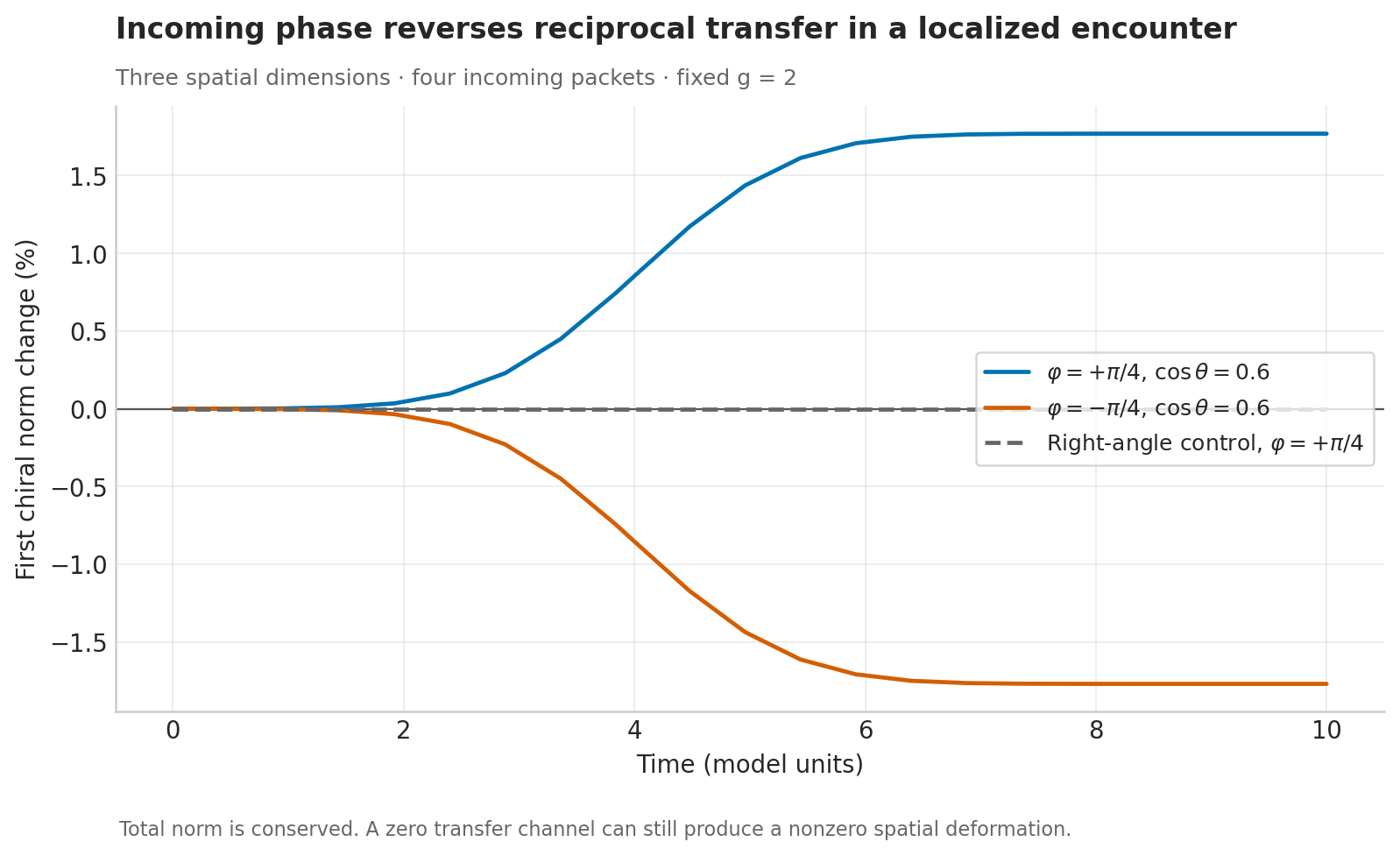
The two nonzero traces use the same , grid. The right-angle trace uses at the same step. Recorded numerical data, the vector figure and plotting code retain the preparations and numerical quantities used in the display.
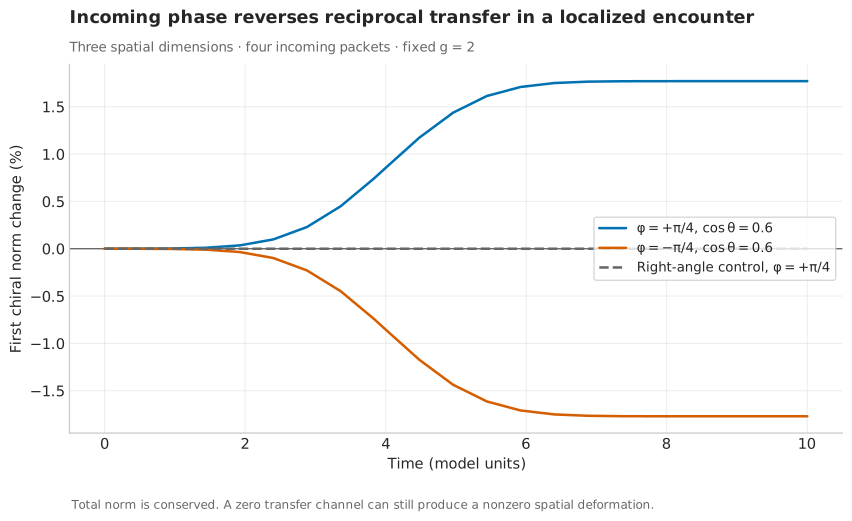
The numerical operator uses an exact free Fourier propagator and an exact local reaction,
in symmetric Strang splitting. The reaction keeps its own pointwise scalar and positive density fixed; the spatial step changes the pattern. The box is storage for a localized-field approximation, not physical compactification. Positive-frequency packets have tails, so exact compact support or a strictly zero boundary signal is not assumed.
| Points per axis | Step | , phase | Maximum energy drift | |
|---|---|---|---|---|
| 64 | 16 | 0.04 | 0.01769528052 | |
| 80 | 16 | 0.04 | 0.01770118605 | |
| 96 | 16 | 0.04 | 0.01770118604 | |
| 80 | 16 | 0.02 | 0.01770168036 | |
| 100 | 20 | 0.04 | 0.01770118606 |
Time-step halving reduces the energy error by approximately four, as expected for this splitting. Spatial refinement from 80 to 96 changes the transfer by about ; the remaining time error is larger. Reporting many numerical digits here exposes convergence, not physical precision.
The full complex fields also converge. Fourier interpolation from 80 to 96 points changes the final field by in positive norm. Halving the time step changes it by . At the same spacing, increasing from 16 to 20 changes the nonlinear response in the common central cube by ; the larger total-field difference, about , includes the changed initial and free tails.
At , changing only the phase gives , within of the opposite-phase magnitude. At and right angles, the transfer stays below over the encounter, while the full field still differs from its free control by about in positive norm. This is a numerical control for the one-polarization transfer node. It does not establish an exact right-angle theorem for all localized continuum data, and it is not zero interaction.
Independent spatial control
A simpler head-on preparation contains one packet in each chiral pattern, with carriers , centers , width two and unit norms. At the same , , its full field differs from free evolution by approximately , with only about chiral norm transfer in the stated refinement. There is phase and spatial deformation without a large norm exchange.
The independently derived axial spatial equation reconstructs this same three-dimensional field using radial Laguerre modes and axial Fourier modes. Its refined nonlinear response agrees with the Cartesian , response to about in full positive norm. Comparing the response means comparing ; the total fields have larger differences from their initial and freely propagated tails. This cross-check uses two different spatial discretizations of the same complete equation.
Reproduction and scope
scalar_packet_collision_checks.py constructs (5), evolves all spatial components through scalar_wave_packets.py, and records both chiral norms, full field changes, energy and momentum. For the positive-phase preparation:
OPENBLAS_NUM_THREADS=1 OMP_NUM_THREADS=1 MKL_NUM_THREADS=1 \
python experiments/scalar_packet_collision_checks.py \
  --packet-size 80 --quartet-cosine .6 --phase .7853981633974483 \
  --step .04 --output-dir experiments/results --save-fields
Change the phase sign for the reciprocal comparison, or set
--quartet-cosine 0 for the right-angle control. Without --packet-size,
the diagnostic runs 101 checks, including independent full spatial ODE
integration, energy variation, time convergence and the complete
reflection identities (7)–(8). Reports and optional field archives have
timestamped filenames.
The calculation confirms a permitted spatial mechanism of the specified scalar term beyond plane-wave truncation. Bound particle shapes, their common physical normalization, their nested-sector channel maps and their measured interaction rates remain to be derived.